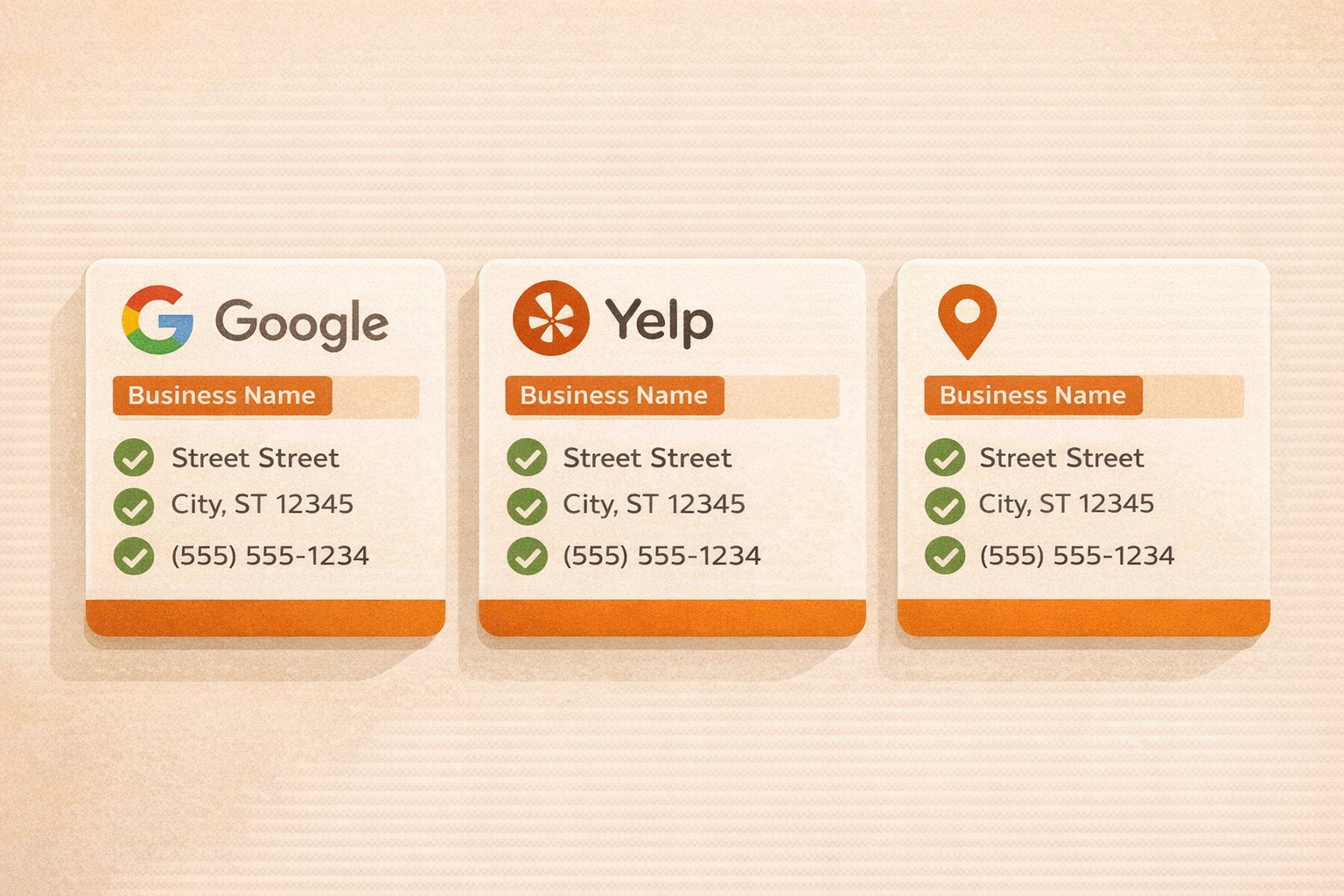
You've got reviews, you've got photos, but your Google rankings are still stuck. There's a good chance NAP inconsistency is quietly working against you, and you don't even know it's happening.
It's not glamorous. It's not exciting. But fixing it is one of the fastest ways to strengthen your local SEO foundation, and you can do it yourself in an afternoon with nothing but a browser and a spreadsheet.
What NAP Actually Means
NAP stands for Name, Address, and Phone number. It refers to how your business is identified across the internet: on your Google Business Profile, Yelp, Facebook, your own website, industry directories, and anywhere else your business shows up online.
The concept is simple: every listing should say the same thing. Same business name, same address formatted the same way, same phone number. When they don't match, you have a NAP inconsistency.
This matters more than most contractors realize. Google cross-references your business information across hundreds of sources to verify that you are who you say you are. Inconsistencies create confusion and reduce Google's confidence in your listing.
Why Google Cares So Much
Think of Google as a fact-checker. Before it ranks you prominently for "HVAC repair near me," it wants to confirm you're a real, established business at the address you claim. It does that by looking at how consistently your information appears across the web.
If your Google Business Profile says "Miller Plumbing LLC" at "142 Oak St Suite 4," but your Yelp page says "Miller Plumbing" at "142 Oak Street" with no suite number, Google sees two slightly different entities. It can't be fully certain they're the same business. That uncertainty weakens your local authority.
Citations (mentions of your NAP on other websites) are one of the core local ranking factors. But a citation only helps you if it matches your primary listing. Mismatched citations can actually dilute your authority instead of building it.
Where Your NAP Shows Up
Your business name, address, and phone number appear in far more places than most contractors track. The major ones:
- Google Business Profile: your most important listing, the one that drives your Maps ranking
- Yelp: heavily used by homeowners looking for contractors, especially in higher-income markets
- Facebook: your business page's About section
- Angi (formerly Angie's List): major lead gen platform for home services
- HomeAdvisor: often pulls data from other sources, so errors propagate
- Better Business Bureau (BBB): high authority domain, Google trusts it
- Apple Maps: more important than people think; iPhone users search here
- Bing Places: smaller share but still worth keeping consistent
- Industry-specific directories: for roofers: GAF, Owens Corning; for HVAC: Carrier, Trane dealer locators; for plumbers: plumbing manufacturer dealer finders
- Chamber of Commerce: local chapters often maintain business directories
- Your own website: the footer, contact page, and any schema markup
The Most Common Inconsistencies
These are the errors that show up over and over when auditing contractor listings. Check for all of them:
- Suite or unit numbers missing. Your GBP says "200 Commerce Dr Suite 12" but your Yelp says "200 Commerce Dr." This is one of the most common errors and creates a clear mismatch in Google's eyes.
- LLC, Inc., or Co. dropped. You registered as "Blackwater Roofing LLC" but half your listings say "Blackwater Roofing." Pick one format and use it everywhere.
- Old phone numbers still live. You got a new number two years ago and updated Google, but your BBB page, your old Chamber listing, and three directories still show the old number. Anyone who finds those listings can't reach you, and the inconsistency hurts your SEO.
- Street abbreviations. "Street" vs "St" vs "St." are technically different strings. Most search engines are smart enough to treat them as equivalent, but it's still worth standardizing.
- Business name variations. "Blue Ridge Electric," "Blue Ridge Electrical," and "Blue Ridge Electric Co." are three different names. Customers won't care, but citation-matching algorithms will.
- Old address from before you moved. If you've relocated, old listings with your previous address are actively working against you.
Pick a Master Format and Stick to It
Before you start fixing anything, decide on the exact, canonical version of your business name, address, and phone number. Write it down. Use this exact format on every listing you update. If your GBP is your most authoritative listing, match everything to that.
How to Audit Your NAP in an Afternoon
You don't need fancy software to do a basic audit. Start with a Google search of your business name in quotes, something like "Miller Plumbing LLC." Look at the first two pages of results. Every listing you find is a citation you need to check.
Open a spreadsheet with five columns: Platform, Listed Name, Listed Address, Listed Phone, and Notes. Go through each result and fill in what the listing actually says. Then compare each row to your master format. Anything that doesn't match exactly goes in the Notes column with what needs to change.
Also search your old phone number in quotes if you've changed numbers. Search your old address too. These searches surface zombie citations that are invisible to you but very visible to Google.
For a more thorough audit, search: your business name + city, your phone number in quotes, and your address in quotes. Between these three searches, you'll surface the vast majority of your citations.
Fixing It Step by Step
Work through your spreadsheet from most authoritative to least. Start with Google Business Profile, then Yelp, Facebook, BBB, and Apple Maps. These carry the most weight and are usually the easiest to update directly.
For each listing, log in with the account that owns it (you may need to use "forgot password" for ones you set up years ago), navigate to the business information section, and update the name, address, and phone to your master format. Save and move on.
Some directories don't have a self-service portal. You have to submit a correction form or contact support. Do it anyway. The high-authority directories are worth the extra step.
For listings you didn't create (like data aggregator sites that scraped your info from somewhere), you'll sometimes need to claim the listing first, then update it. Create an account, claim the business, verify it (usually via phone or postcard), and then make the correction.
Prioritize These Five First
If you only have an hour: fix your Google Business Profile, Yelp, Facebook, Apple Maps, and your own website footer. These five carry the most ranking weight and reach the most customers. Everything else is secondary.
Tools That Speed This Up
If you have more than 20 citations to fix, or you want ongoing monitoring, two tools are worth knowing about:
BrightLocal is built specifically for local SEO. Their Citation Tracker finds your existing listings across 300+ directories, shows you exactly what each one says, and flags mismatches against your master NAP. You can fix many of them directly through their dashboard. Pricing starts around $29/month, reasonable if you're doing this for more than one location or want to stay on top of new inconsistencies that appear over time.
Moz Local takes a different approach. You enter your correct NAP information and they push it out to their network of data aggregators, the databases that many directories pull from. Fix the aggregators and you fix many downstream directories automatically. Good for establishing a clean baseline, though manual follow-up on the major platforms is still necessary.
For most small contractors, a manual audit every 6 months plus one of these tools for ongoing monitoring is all you need.
How Long Before You See Results
NAP fixes are not instant. After you update a listing, it can take Google anywhere from a few weeks to a couple of months to crawl the updated page, process the corrected information, and factor it into your ranking. Data aggregators sometimes take 60 to 90 days to update downstream directories after you correct the source.
Don't expect to fix your citations on Monday and rank first on Friday. Think of this as laying a foundation. The rankings you build on accurate, consistent citations are stable and hard for competitors to undercut.
Within three months of a thorough cleanup, most contractors see a measurable improvement in their local pack visibility, especially in neighborhoods and zip codes where their citations were most inconsistent.
Make It a Habit, Not a Project
Once you've done the initial audit and cleanup, schedule a check every six months. New citations appear all the time. Directories you never submitted to scrape your info from aggregators and sometimes get it wrong. A quick search of your business name every six months catches problems before they compound.
Whenever you change your phone number, add a location, rebrand, or move offices, treat a NAP audit as a mandatory follow-up task. Those are the moments when inconsistencies are most likely to appear and do the most damage.
It's boring work. But it's the kind of boring work that separates contractors who dominate their local market from ones who wonder why their competitors keep showing up above them.